For our 25 Stories for 25 Years series, we’re honoring the parents, caregivers, youth, and community leaders whose experiences have shaped this movement.
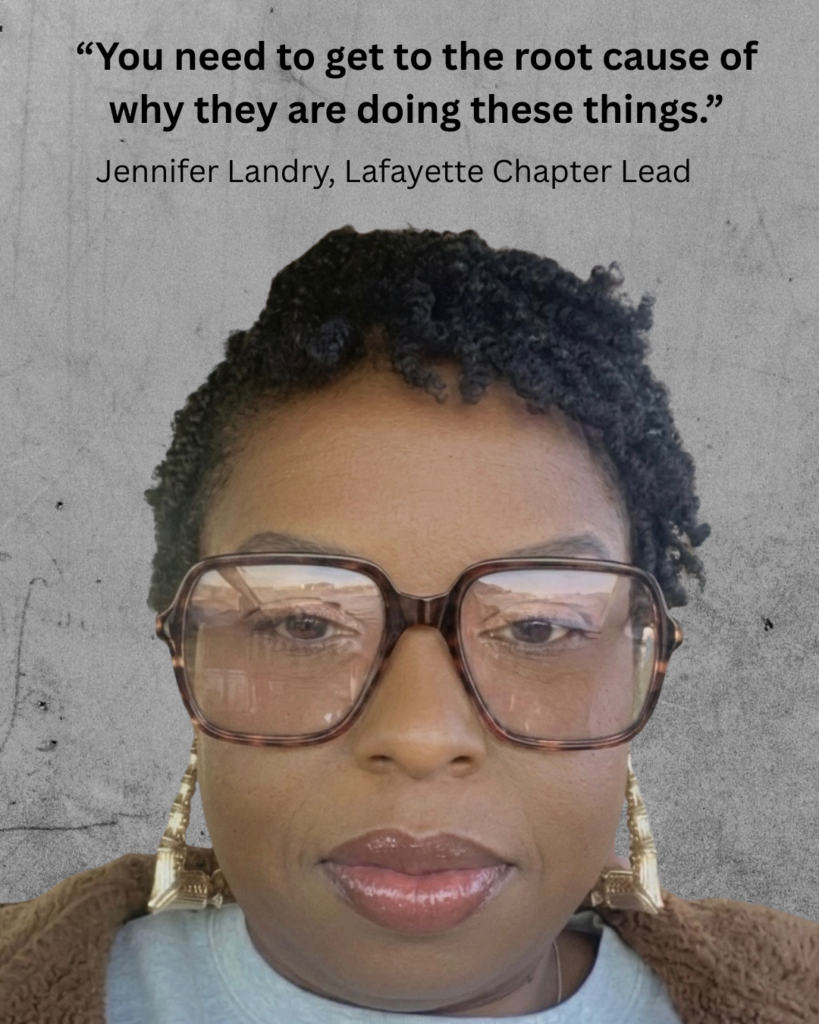
Jennifer Landry is one of those leaders.
As a chapter leader in Lafayette, advocate, grandmother, mother, and community organizer, Jennifer has become a trusted voice in conversations that are often difficult and deeply personal. She has the rare ability of a true leader to hold compassion and accountability in the same space, to ask hard questions without losing sight of people’s humanity, and to remind us that the stories behind harm are often more complex than they first appear.
Some stories fit neatly into categories. Jennifer’s does not.
Over the years, she has experienced incarceration, loss, advocacy, and healing from more than one perspective. She has supported loved ones behind bars, advocated for children in schools, lived through unimaginable grief, and worked alongside families searching for answers.
Because of those experiences, Jennifer doesn’t accept easy answers.
What follows are a few reflections from Jennifer, shared largely in her own words.
_________________________________________________
What I Know About Incarceration
Over ten years ago, my brother was arrested for murder. While he was incarcerated, my goal was always to make sure that he was treated well while he was there.
I became an advocate for anybody in that position.
Over the years, incarceration touched my life in more than one way.
I worked at a work release facility, where I saw how easily people could be stripped of their humanity.
I remember one man whose mother had just died. He was sitting on his bed crying when I was told to go in and shackle him up so he could be sent back. I remember thinking, his mom just died. Give him some time.
I was hurt watching that happen.
Having people I love impacted by incarceration, and seeing how other people were treated inside those systems, made me want to do more.
My husband and I met while he was incarcerated, and we were married while he was still in prison.
What I Know About Advocacy
The thing that really drew me to FFLIC was the advocacy work.
I had a granddaughter who was dealing with issues in school, and I had no idea my rights as a parent. Dealing with her and having an IEP and 504s, I didn’t know what that meant. All I knew is I would go to school, they would give me a paper to sign, and I would walk away.
I never knew I had rights.
Working with FFLIC gave me knowledge. Knowledge of some of the things I didn’t know beforehand. Advocacy work. The school-to-prison pipeline. The rights that parents have.
That’s one of the biggest impacts it’s had on me.
What I Know About Grief
In 2016, my 17-year-old daughter was murdered by the father of her children. She was pregnant at the time and she also had a daughter who was one year old.
It took me a while to get into a position where I could forgive.
Any mother would say the person that hurt my child, I want them to hurt just as bad as I hurt.
For years, that’s where I was.
If you lost a child as young as my child was, imagine talking to your child one day and the next day getting a phone call.
That was my reality.
For years, I wanted an eye for an eye.
What I Know About Accountability
Working with FFLIC, dealing with youth, doing research, and learning about advocacy work and the fact that a child’s brain isn’t fully developed until they’re 25, made me look at things differently.
This was a child.
Yes, he hurt my child. Yes, he took my child. Yes, he took my grandchild.
But he was also a child who had been dealt a bad hand.
He dealt with abuse. He dealt with a mother that was incarcerated. He dealt with things that no child should have to deal with.
I believe rehabilitation is important.
You need to get to the root cause of why they are doing these things.
What makes you go out and steal something from a store? What makes you do some of the things that you do?
You need to figure out the root cause.
What I Know About Young People
We visited an alternative school, and there were little children there.
Five years old.
You walk through the line, take off your shoes, get your shoes patted down, and walk through a metal detector.
They’re five.
I asked what would make them bring a five-year-old into an alternative school, because the child is five. What could they have done so bad?
One of the administrators said one child had been caught watching something inappropriate.
But why are you punishing them?
You need to figure out the root cause of why they are watching something inappropriate instead of punishing them.
They don’t know no better.
They’re children.
I’d rather see a child rehabilitated and get to the root cause of why they are doing some of the things they’re doing.
Some of the resources children need are counseling, proper education, mentorship, and support systems from family.
What I Know Now
I have empathy and compassion for people that are dealing with racial issues. As a Black woman living in America and having experienced those things, I have a heart for people that are going through them.
Seeing that is heartbreaking, and I feel compelled to help.
I’ve learned that children need support. Families need support. Communities need support.
And I’ve learned that before we decide what comes next, we have to be willing to understand what happened first.
Editor’s Note: Jennifer’s story reminds us that lived experience rarely fits into neat categories. We share it in the hope that it encourages deeper conversations about accountability, healing, and what young people need to thrive.