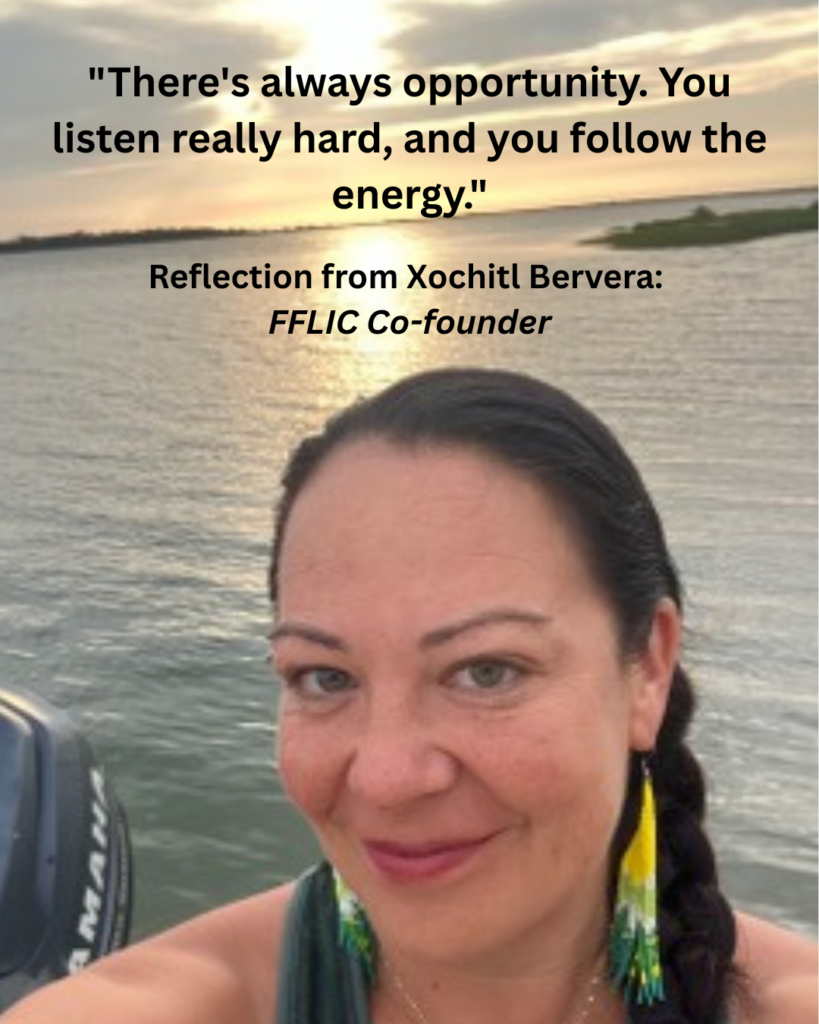
When Xochitl Bervera first arrived in Louisiana as a law student intern with the Juvenile Justice Project of Louisiana (JJPL), she already knew she wanted to be an organizer.
Before coming to New Orleans, she had spent years working alongside young people in California and saw firsthand how incarceration disrupted their lives and communities. Again and again, she watched promising youth leaders disappear into the justice system.
“I’d ask, ‘Where’s Joaquin?’ and somebody would say, ‘He got arrested again.'”
That experience drew her toward criminal justice work and eventually to Louisiana, where she met the office manager named Gina Womack.
Neither knew they were helping lay the groundwork for what would become Families and Friends of Louisiana’s Incarcerated Children (FFLIC).
At the time, Gina was often the first person parents called when their children became entangled in Louisiana’s youth incarceration system.
“She had all these stories,” Bervera recalled. “She was talking to parents every day.”
To Bervera, who always saw herself as an organizer first, the next step was obvious: calling those parents together for a meeting.
One of those first gatherings in Baton Rouge became a defining moment.
Parents were asked a simple question: What do you want for your children and family?
“The realization,” Bervera said, “was that some of the things lawyers were fighting for weren’t the things parents wanted.”
Rather than asking families to support an agenda developed by lawyers or policy experts, she and Gina began building around the priorities identified by the people living through the system every day. Parents were not invited into someone else’s campaign. They became leaders of their own movement.
Those early meetings grew into leadership committees, local chapters, and a statewide network of families determined to change Louisiana’s youth justice system.
Much of that organizing power came together in the campaign to close the Tallulah Correctional Center for Youth, one of the nation’s most notorious youth prisons.
For families, Tallulah was extremely personal. Parents spent hours traveling to visit their children and witnessed firsthand the harm caused by a system that separated young people from their families and communities.
As the campaign grew, parents, youth, advocates, lawyers, and allies came together to demand change.
The result was Act 1225, the Juvenile Justice Reform Act of 2003, and the eventual closure of Tallulah.
Looking back, Bervera laughs at the idea that the campaign was ever tidy.
“It was a very interesting collaboration between the grassroots and the lawyers,” she said. “There was crying. There was yelling. There was fighting.”
But there was also trust, shared purpose, and a belief that families could accomplish what many considered impossible.
The campaign’s success reinforced a lesson that continues to guide FFLIC today: the people closest to the problem are often closest to the solution.
For Bervera, the significance of FFLIC’s work was never confined to one campaign or one piece of legislation.
Following Tallulah’s closure, organizers and families began asking larger questions about what young people need to thrive and what communities need in place of prisons.
That vision of transformation remains one of the organization’s defining strengths.
When Bervera reflects on FFLIC’s impact, she points not only to the closure of Tallulah but to the thousands of young people who have avoided incarceration because families organized and demanded something different.
“When FFLIC started, there were thousands more kids behind bars,” she said. “Because of our work, there are thousands fewer children behind bars today.”
Since leaving Louisiana, Bervera has continued building power in communities across the South. In Atlanta, she founded the Racial Justice Action Center, which helped incubate organizations that continue leading work around decarceration, community safety, and alternatives to policing. Among them are Women on the Rise, SNAPCO, and Policing Alternatives & Diversion, a groundbreaking initiative that gives residents options beyond calling 911 during nonviolent crises.
Today, she organizes in a different way as an oyster farmer on the Gulf Coast while supporting immigrant communities facing detention and deportation.
Yet when she reflects on the lessons that have stayed with her throughout decades of movement-building, she returns to those early meetings with Louisiana families.
“FFLIC was never built on Act 1225,” Bervera said. “FFLIC was built on the voices and leadership of formerly incarcerated young people, parents of incarcerated kids, and impacted communities.”
Twenty-five years later, that commitment remains at the heart of the organization.
As FFLIC continues organizing families, developing youth leaders, and advancing the youth-led #NoMorePrisons campaign, the lesson of those early years remains as relevant as ever: lasting change happens when the people most affected are trusted to lead.