Talisha thinks a lot about seasons. About what we learn in one season that we carry into the next. About what needs to be planted before anything can grow. About how an idea becomes something you can actually touch.
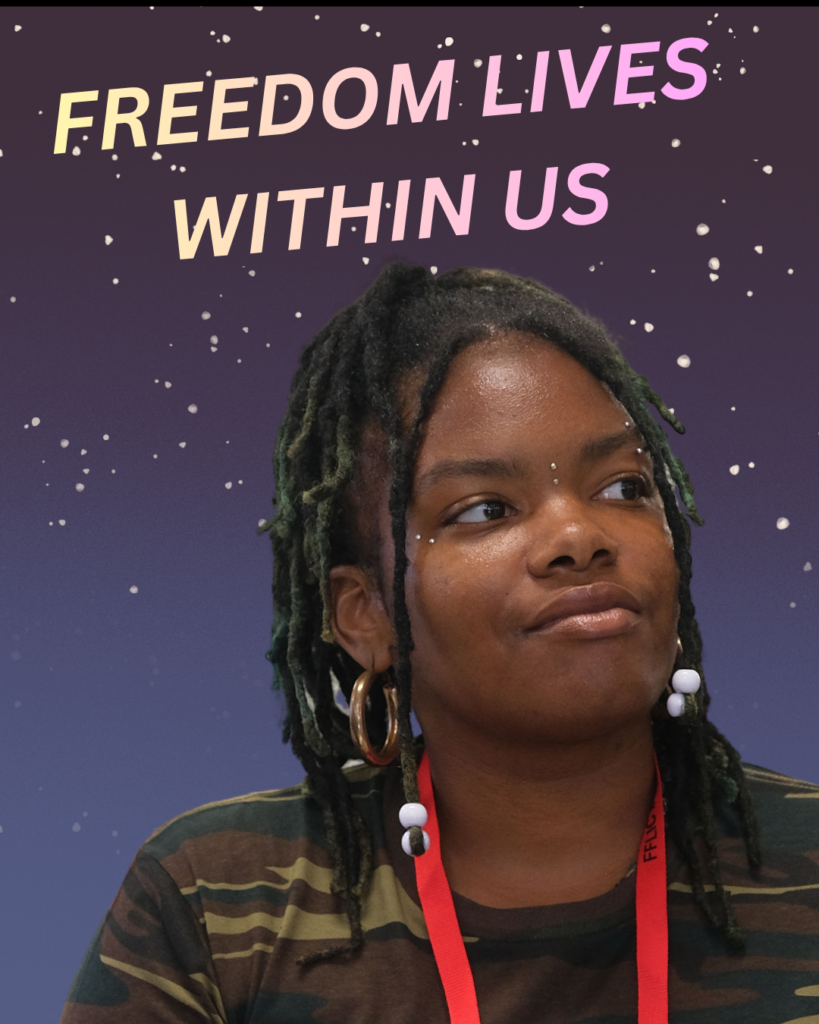
This fall, one of the seeds she has planted is about to sprout. Soon, drivers in New Orleans will pass a billboard of Talisha and an idea she has been living with:
Freedom is within us.
We aren’t revealing the full billboard just yet. But to understand the message, you have to understand a little about the person behind it.
Talisha is 25. She is an artist, entrepreneur, teacher, mentor, and organizer. Her roots stretch across the South. Her ancestors are from Mississippi. She was born in Savannah, grew up largely in Jacksonville and came to New Orleans for college in 2019. She stayed because she found room here for the things she cared about: land, spirituality, poetry, writing and community.
New Orleans, she says, helped her “see my roots deeper.”
Those roots reach back to a childhood church in Jacksonville, a place Talisha remembers as much more than a place of worship. There was a community center. Singing. Youth activities. Doodling. Doing hair. Her aunt taught her to braid there, which is now how she mainly makes an income.
Looking backward, she can see the connection between that childhood and the spaces she tries to build today.
“I feel like I always try to recreate that support for other youth,” she says.
In some ways, that is the story of Talisha’s leadership: creating the spaces she once needed.
Freedom Is Within Us
For Talisha, questions about what people need to thrive aren’t abstract. Neither is incarceration.
Her father has been incarcerated throughout parts of her life, an experience that has pushed her to think deeply about the systems that shape people’s lives and what might exist in their place. Her work with young people has deepened those questions.
For Talisha, that connects “Freedom Is Within US” directly to FFLIC’s #NoMorePrisons campaign.
“For No More Prisons to be a reality,” she says, “the freedom within us is like the foundation for that existing.”
She’s talking about developing a belief in our capacity to create something different.
“I need people to know that they don’t need prison,” she says. “I need for people to think that we can solve our own problems.”
In her vision, closing prisons is only part of the work. Communities must be able to imagine how we care for one another, respond to harm and build the structures people need to live.
And she believes the knowledge to do that already exists within us.
“We have the answers,” Talisha says. “We’re unlocking it more and more and more.”
That’s why the ‘us’ in her message matters.
Freedom may begin with recognizing what you carry within yourself, but Talisha doesn’t see it as an individual journey.
“The more that you look into yourself and lean on your strengths, and figure out your weaknesses and figure out how you can work on them, the stronger the collective will be,” she says. “Freedom lives within you individually, but when you tap into your inherent stuff inside of you, it charges the rest of the world.”
That’s what she wants another young person to feel when they see the billboard.
“I want them to feel activated,” she says. “I want them to see it and be like, ‘Oh yeah, I see myself in that.'”
A Leader Before She Knew the Word
Talisha doesn’t remember exactly when she became a leader.
Maybe because there wasn’t really a beginning.
She’s the eldest child, and her mother told her not to be a follower. Her Mississippi family taught her about Black thinkers and people who devoted themselves to something larger.
“My mama always told me, ‘don’t be no follower,’” she says, “so I probably was already a leader before I knew that I was.”
Of course, FFLIC didn’t make Talisha a leader. The raw materials were already there. But over the past couple of years, FFLIC has offered her opportunities to mold and shape her leadership by testing and strengthening what was already there.
Talisha has taught classes, mentored young people, traveled across the country and stretched herself to communicate her ideas to new audiences.
A year ago, she describes herself as passionate but scattered. Today, she talks repeatedly about clarity.
“I want to be more clear. I want to be more concise,” she says. “I care deeply about a lot of things, and I want it to be understood.”
She’s also learning that she doesn’t need to figure everything out at once. She can build something, learn from it and build the next thing. And increasingly, she’s thinking about how to create those opportunities for others.
During a recent trip to Philadelphia, Talisha learned about leadership pipelines. One lesson stayed with her:
“You don’t need to be the only leader. You need to make sure there are other people who are ready to be leaders as well.”
The billboard represents another step in that growth, with new opportunities to write, speak, organize and sharpen her message.
Sometimes seeing those ideas become real still feels surreal.
“Oh, we really here now,” she says. “Just seeing different stuff come to life, that’s the coolest part.”
Soon, one of those ideas will be big enough for New Orleans to see.
Freedom is within us.
The billboard will carry Talisha’s image. But more than that, she’s hoping the people who pass it see something else, too: themselves.