While much of the state’s organizing is often associated with larger cities, the story of youth justice advocacy in Louisiana cannot be told without Lake Charles. For years, families across Southwest Louisiana found support, information, and community through the Lake Charles chapter.
Parents arrived carrying questions they didn’t know how to answer. They arrived worried about their children, frustrated with systems, and unsure where to turn next.
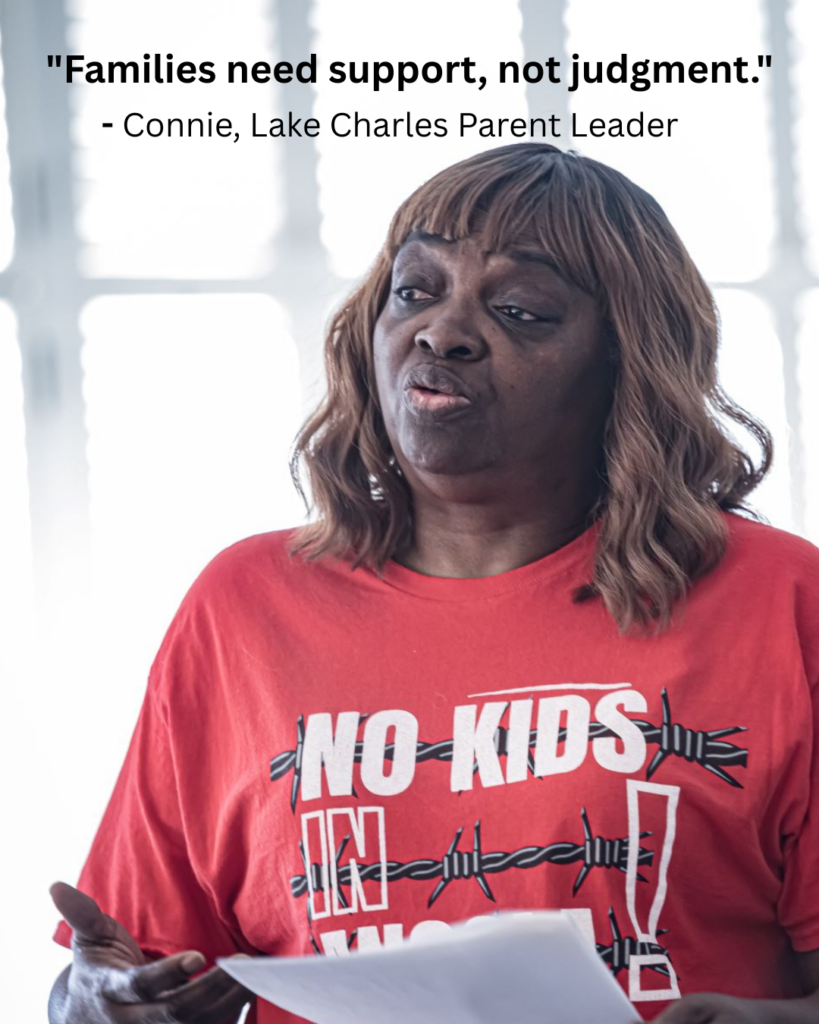
Often, they found Ms. Connie Lewis.
Over the years, Ms. Connie has become one of the people many families could count on. Having walked her own difficult road as a parent, she understood what it felt like to be searching for help. She also understood the power of finding it.
We are sharing Ms. Connie’s story because her journey reflects the journey of so many families. It is a reminder that parents facing these challenges are not alone, that support and community can change the course of a family’s story, and that some of the most powerful leaders begin as parents simply trying to help their children.
Like many FFLIC leaders, Ms. Connie did not set out to become an advocate. She was a mother looking for help for her son. But then she became a community leader.
What follows is her story, shared in her own words.
____________________________
My son had been going in and out of jail, and my hands were tied. I didn’t know which way to go. We knew that he had some mental health issues, and he just kept going in and out of jail. I was trying to find some help– to help us help him.
That’s when somebody told me about FFLIC.
I first got involved through the chapter leads for the Lake Charles chapter at that time, and when I went to the first chapter meeting, I was hooked. What really pulled me in was the way they were encouraging mothers and family members to advocate for themselves and to stand up strong for their family members. Through the chapter meetings and through talking with other families, I learned how to stand up and be a voice for my son.
They taught me how to advocate for my son through the school system and how to navigate around a lot of the school-to-prison pipeline issues we were having with him.
I didn’t know that a lot of things were set up in order to route our kids into the juvenile justice system. Learning that changed the way I looked at what my son and our family were experiencing. I stopped blaming myself, and learned a lot about mental health issues, which was something that was affecting my son. I also learned how to work with people to help him even when he was inside the system who would keep a good eye on him and make sure he was okay. That really encouraged me, and it encouraged me to tell other people about FFLIC who were going through the same thing.
Over time, I realized I wasn’t the only parent carrying these struggles.
A lot of times, people don’t know what they need until they have a chance to talk about it. We were able to talk about the needs our families had and learn from one another. When we let people know what we needed, we were able to learn, and we were able to go on and advocate for ourselves.
Some parents were trying to navigate school discipline issues. Others were dealing with mental health challenges or trying to understand what would happen next for their child. Many of them felt overwhelmed and didn’t know which way to go.
I understood that feeling because I had lived it.
I eventually became a leader in the Lake Charles chapter. What I learned is that everybody starts from a different place. Some people already have knowledge about these issues, and some people are just beginning to learn.
Everybody has different views, but at the end of the day we’re all trying to help one another and help people in this fight against the systems.
Really, it’s about helping other people stand up and be a voice.
People often say, “That could never be my child.”
Such was me.
I didn’t think my child would end up involved in the system either. But there are a lot of things that can lead children down difficult paths, including mental health challenges and a lack of support.
If it is your child, don’t worry about that. You can still be that parent who stands up for your child and helps them become better. Families need support, not judgment.
Sometimes parents are ready to pull their hair out because they don’t know which way to go. Sometimes people don’t want to talk about mental health. Sometimes they don’t want to admit their child needs extra help.
But I think that’s where it starts. People being honest about what’s going on and what help they need.
From FFLIC: May Ms. Connie’s story be a guide for every parent who has ever felt like they didn’t know which way to go. May it remind them that they are not alone.