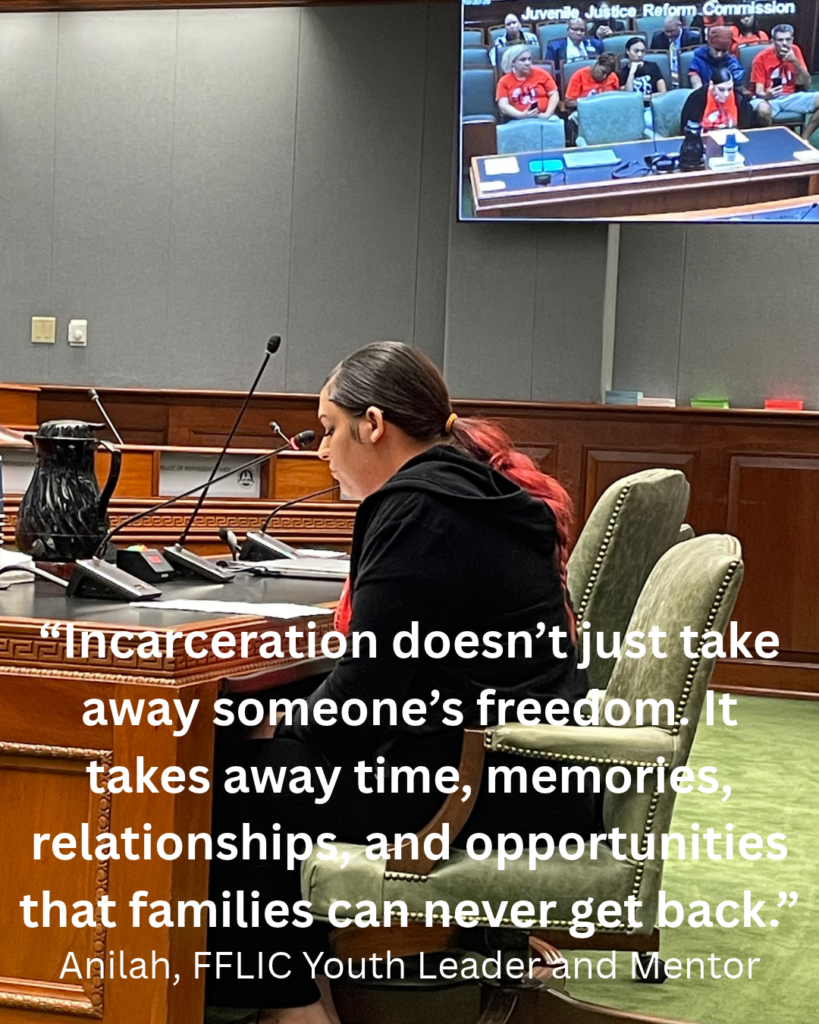
On October 20, FFLIC youth leader and mentor Anilah Landry addressed the Juvenile Justice Reform Act Implementation Commission (JJRAIC), sharing how incarceration affects not only young people but also their families and communities.
Drawing from her own experiences growing up with an incarcerated father and supporting brothers involved in the youth justice system, Anilah spoke about the emotional, relational, and long-term impacts of incarceration. Her testimony reminds us that when a young person is removed from their family and community, the consequences extend far beyond the individual.
How Incarceration Affects Youth, Families, and Communities
JJAIRC Speech by Anilah Landry
Good morning, everyone.
My name is Anilah Landry, and today I want to talk about how incarceration affects more than just the person who is locked up. It affects their children, siblings, families, and entire communities.
I know this from personal experience because incarceration has affected my own family.
My father went to jail when I was three years old, and I didn’t meet him until I was around 14. Growing up without my father was hard because I missed out on years of having him present in my life. I grew up without those memories, guidance, and father-daughter moments that many children get to experience. It taught me that when a parent goes to jail, their child can feel that loss, too. The parent may be the one behind bars, but the child is also affected emotionally.
My brothers have also been in and out of the juvenile justice system since they were young, and they are still facing trial today. As their sister, I worry about them and their futures. It affects me and my family because we carry the stress, fear, and uncertainty of not knowing what will happen next. When someone you love is involved in the justice system, it doesn’t just affect them. The whole family feels it.
Incarceration doesn’t just take away someone’s freedom. It takes away time, memories, relationships, and opportunities that families can never get back.
Our communities are affected, too. When young people are removed from their homes, schools, and communities, they lose opportunities to learn, grow, and receive the support they need. Instead of only focusing on punishment, we need to ask what support, resources, and opportunities could help prevent young people from entering the system in the first place.
I believe we need more mentorship, mental health resources, educational opportunities, safe spaces, and restorative justice programs. Young people should be held accountable, but they should also have the chance to learn, heal, and make better choices. We cannot expect our youth to succeed if we are not willing to invest in them.
As a youth mentor and someone who cares about justice reform, I want to use my voice to speak up for young people and families like mine. I know what it feels like to grow up without a father, and I know what it feels like to worry about my brothers and their futures. These experiences have shown me why change is necessary.
Today, I ask everyone to look beyond the jail cell. Think about the child waiting for their parent, the sibling worrying about their brother or sister, and the family trying to stay strong through it all.
When one young person is incarcerated, an entire family can feel the impact. When families struggle, communities feel that impact, too.
Our youth deserve more than punishment. They deserve support, opportunities, and a chance to build a better future. Our families deserve resources, our communities deserve healing, and our young people deserve to know that their lives are worth fighting for.