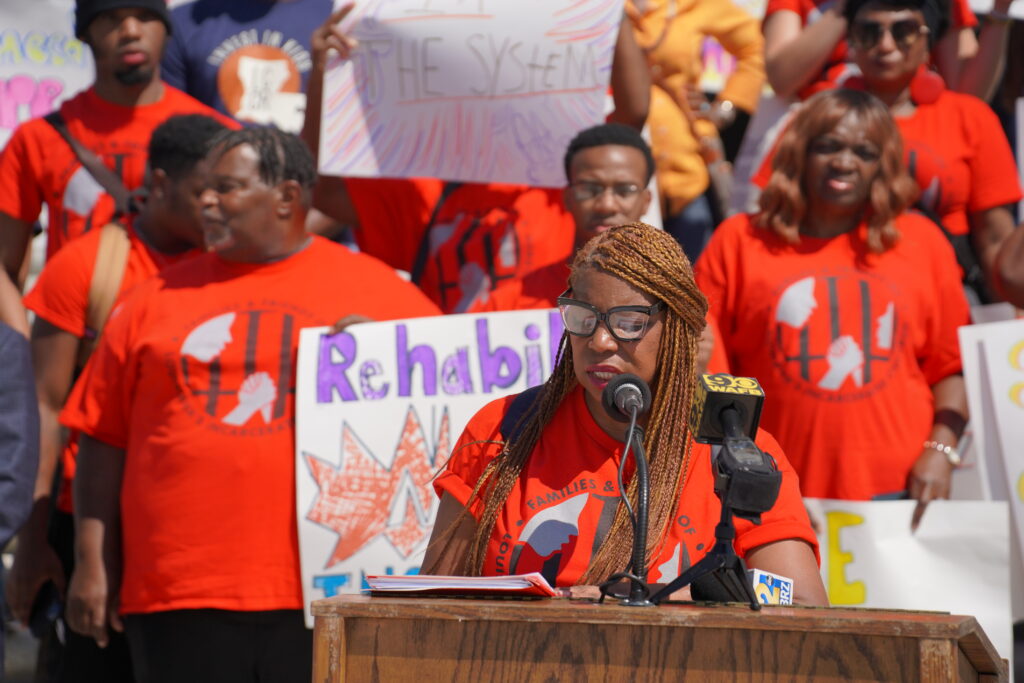
Twenty-five years ago, a Black mother answering a phone in a legal office helped change the course of youth justice in Louisiana. Today, that mother—Gina Womack, co-founder and executive director of Families and Friends of Louisiana’s Incarcerated Children (FFLIC)—stands as a defining voice of community power, policy reform, and unwavering love. For Women’s History Month and FFLIC’s 25th anniversary, we honor Gina’s leadership and the legacy she continues to build with and for families.
Gina’s path to movement leadership began in 2000, when she worked as office manager at the Juvenile Justice Project of Louisiana (JJPL). Day after day, she took calls from parents terrified for their children—stories of isolation, judgment, and a system that seemed designed to swallow young people whole. “I just felt like parents needed a place where they could come together,” Gina recalls. She asked to start a support group. Families came. They shared. And they organized—joining JJPL’s lawsuit over conditions of confinement and recognizing, many for the first time, that they were not “bad parents.” They were navigating a system built to channel their children into incarceration. That realization birthed FFLIC.
Gina likes to say she came to the work by happenstance but stayed because she understood her liberation was bound up with the liberation of others. Newly single at the time, raising three children—including two Black sons—without a college degree, she recognized herself in families who called for help. The difference, she saw, was access. “There wasn’t anything special about me,” she says. “I’m just a human being trying to survive—like our families. We should have access to the same.” The idea that parents had to see their children enter the criminal legal system just to receive services—mental health care, tutoring, stability—was, to Gina, “horrifying.” FFLIC became the community’s answer: a place to replace judgment with dignity, isolation with organizing, and despair with advocacy.’
That plan has always centered family power and political education. FFLIC equips families to understand and navigate systems. Families learn to advocate, testify, set agendas, and reshape policy together. Early on, that approach produced a watershed victory: the Juvenile Justice Reform Act of 2003 (Act 1225). The law laid out a road map to move Louisiana from punitive incarceration toward community-based alternatives, shift resources from the “deep end” of the system into local supports, and coordinate agencies so families wouldn’t have to run in circles for basic services. In the years following the passage of the law, FFLIC, along with its parents and advocates have participated in numerous events, strategies, and tactics to change the injustices happening in youth prisons. Because the promises of Act 1225, which was to transform the justice system into a model of care and support for children, never happened.
While Gina learned that policy wins do matter, when Gina talks about success, she returns to something deeper: transformation. Success, she says, is when a parent who’s been made to feel small realizes, “I have this power, and I’m not giving it back.” Policy can ebb and flow. That kind of power endures.
At the core of her vision is a world where youth prisons are unnecessary because children are supported long before they are punished. For Gina, that world looks like possibility—space for young people to dream, to hope, to access care, education, and opportunity without having to be criminalized first. It looks like communities resourced to nurture rather than surveil, and safety nets that catch families instead of pushing them toward courts and cages. It looks like joy.
As she reflects on her journey and leadership, what she hopes to pass on is: wisdom, gratitude, and authenticity—especially to the young leaders who will inherit the work she and so many families began. She wants them to see their own power clearly and to trust that their voices are essential.
“Young people shouldn’t have to be afraid to go to prison,” Gina says. Nor should parents ever feel forced to turn to incarceration as the only way to access services. Yet for 25 years, in the face of these painful realities, Gina has transformed heartbreak into strategy and isolation into collective power—turning individual stories into a movement that refuses to give up on its children.
This Women’s History Month, we honor Gina Womack—a mother, organizer, strategist, and visionary whose leadership has carried families through both victories and disappointments. For twenty-five years, she has stayed rooted in the truth that even when systems fail to fulfill their promises, families do not lose their power. Gina’s work has shown that real transformation begins with the people most impacted leading the way, and her persistence continues to light the path toward the world every child deserves.