Since its founding in 2001—and even before, when it existed simply as a project—FFLIC has always been a community grounded in the strength, leadership, and vision of parents and families directly impacted by youth incarceration. Many of the earliest members were parents whose children were imprisoned at places like Tallulah, then one of the nation’s most notorious youth prisons. Their collective determination to close that facility and transform the system became the foundation on which FFLIC was built.
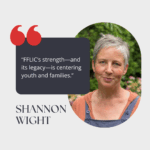
Alongside these families were a number of advocates offering legal and institutional support. Among them was Shannon Wight, whose role helped shape early infrastructure. These supporters remind us that the call for justice reaches far beyond those directly harmed by the system—and that people who are not directly impacted have an obligation to stand beside those who are. Shannon’s involvement, like that of others in similar roles, illustrates how allyship can complement and amplify the leadership of families.
Witnessing FFLIC’s work helped Shannon see that “there isn’t one way to change a system, but we need all the ways.” As she describes, meaningful change requires people working in multiple lanes—those navigating legislative processes, and those who are directly impacted showing up at the capitol, testifying, sharing their stories, and putting forward real solutions. Her experience with FFLIC deepened her understanding of why movements need many approaches, all grounded in the leadership of the people most affected.
Shannon traces her path into social justice to her teenage years in Portland, Oregon, where she began volunteering with people experiencing homelessness. Later, while transporting a Black family from a shelter in Washington, D.C. to their new apartment, she was pulled over by police—an experience that sharpened her awareness of systemic racism and pushed her toward criminal justice work. After several years in the field, she helped co-found the Juvenile Justice Project of Louisiana (JJPL) with David Utter and Gabriela Celeste in the late 1990s.
During her time at JJPL, Shannon met Gina Womack—now FFLIC’s Executive Director. “We were doing a lot from a policy and law perspective,” she recalls, “but Gina was answering calls from parents who were distraught, and she wanted to do more.” Out of Gina’s commitment to supporting parents and building their power, FFLIC was born. The organization began as a JJPL project before becoming independent, and Shannon remembers that era as one defined by “dynamic and healthy tension”—the kind that strengthens movements. Gina and the parents consistently lifted up their immediate needs and systemic demands, grounding the policy work in the realities of those most impacted.
For Shannon, FFLIC’s enduring strength—and what she sees as its legacy—is the unwavering centering of youth and families in the fight to close prisons. She recalls how powerful it was when Louisiana showed up to a national conference on the issue of juvenile life without parole. Most people at the conference were lawyers or policy experts, but Louisiana sent two parents of incarcerated youth. “There were a lot of leaders,” she notes, “and Louisiana was showing up really differently—and that was fueled out of the work that FFLIC started.”
Today, as Shannon continues her work in racial justice and criminal justice reform—including her role at an organization that advocates for both survivors of crime and people convicted of crime—her early experiences with FFLIC continue to influence her. Reflecting on the current youth justice landscape, she says, “In the end, the biggest challenge is helping people to see this is a behavioral health issue…because the system is fundamentally harmful and tears families apart. We need real solutions—not just building better cages.”
FFLIC continues to embody that commitment. The organization remains steadfast in its fight to close all youth prisons and redirect investment toward true alternatives that strengthen families and communities. Our youth-led #NoMorePrisons campaign is currently focused on stopping new facilities proposed by the Office of Juvenile Justice—carrying forward the legacy of parent and youth leadership that has always defined FFLIC’s work.