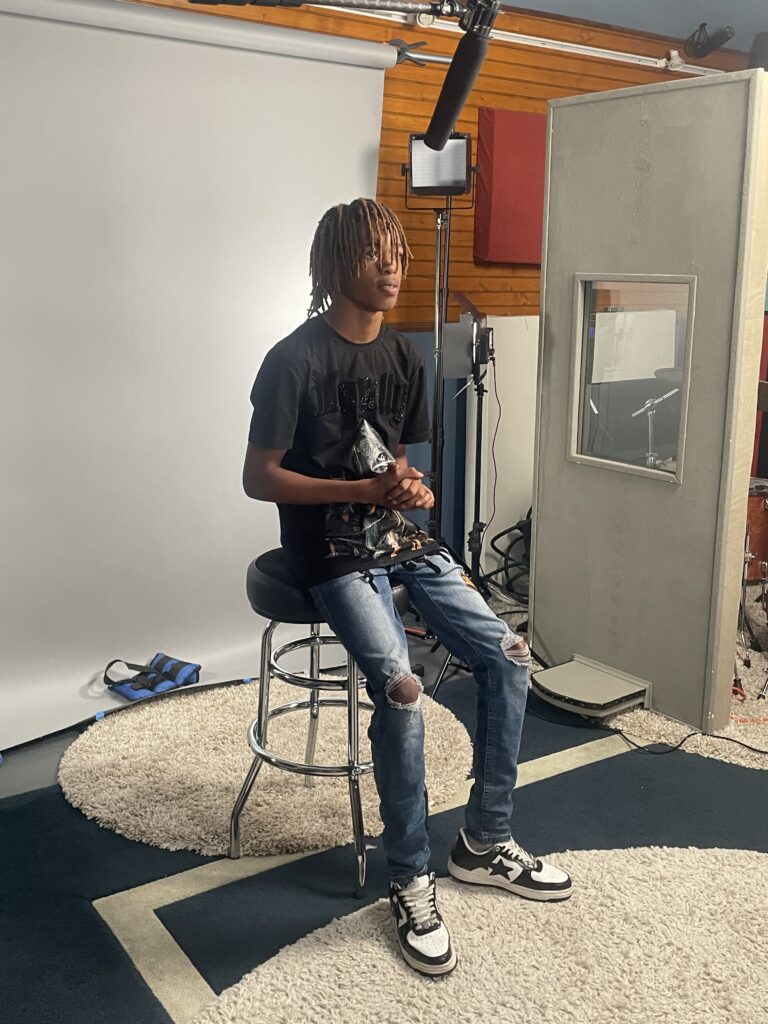
At just 17 years old, Harold had already faced challenges that many adults would struggle to overcome. Growing up in a community surrounded by violence, he saw how quickly young people could be pulled into cycles of harm and incarceration. When one of his closest friends was killed, Harold said he realized “it would have made a difference if he had just had someone to talk to.” That loss pushed him to start thinking about how change was possible.
His path led him to Black Man Rising (BMR) and then to Families and Friends of Louisiana’s Incarcerated Children (FFLIC). For the first time, Harold experienced what it felt like to have a truly safe space. “When I started talking about what I was going through, I felt relieved,” he explained. “It was like a weight lifted off my shoulders.”
In Black Man Rising, Harold found what he describes as a brotherhood: a family where people looked out for one another and held each other accountable in ways that came from love, not control. That foundation grew even stronger when he became more deeply involved with FFLIC. There, he discovered his own potential as a leader and learned the importance of conflict resolution, community accountability, and visioning a better future.
The impact was clear in his everyday life. Before FFLIC, Harold often found himself caught up in conflicts on the streets. But through the organization, he said he learned how to let go of grudges and resolve old disputes. “Now, when I’m walking around, I don’t feel unsafe anymore,” he shared. “I know I’ve let things go and can move forward.”
Harold describes FFLIC as passionate, full of good energy, and powerful. To him, it’s a place where young people can learn, laugh, and grow while also standing firmly for justice. It’s also where he discovered new talents. With encouragement from his BMR mentors, Harold began exploring music, art, and trades. He found confidence in knowing he was good at something and, more importantly, that he could be himself while doing it.
Looking ahead, Harold dreams of a world without youth prisons—a world he envisions as more peaceful, where young people are building connections at community events instead of being separated by conflict. “We don’t need punishment,” he said. “We need outlets—safe spaces where we can talk, release stress, and feel supported.”
For Harold, BMR and FFLIC have been life-changing. His involvement with the two organizations has helped him see his own worth, strengthened his leadership among peers, and reminded him that he is part of a powerful legacy of change. “The people really care,” Harold said. “They’ve shown me I matter, and that I can make a difference too.”