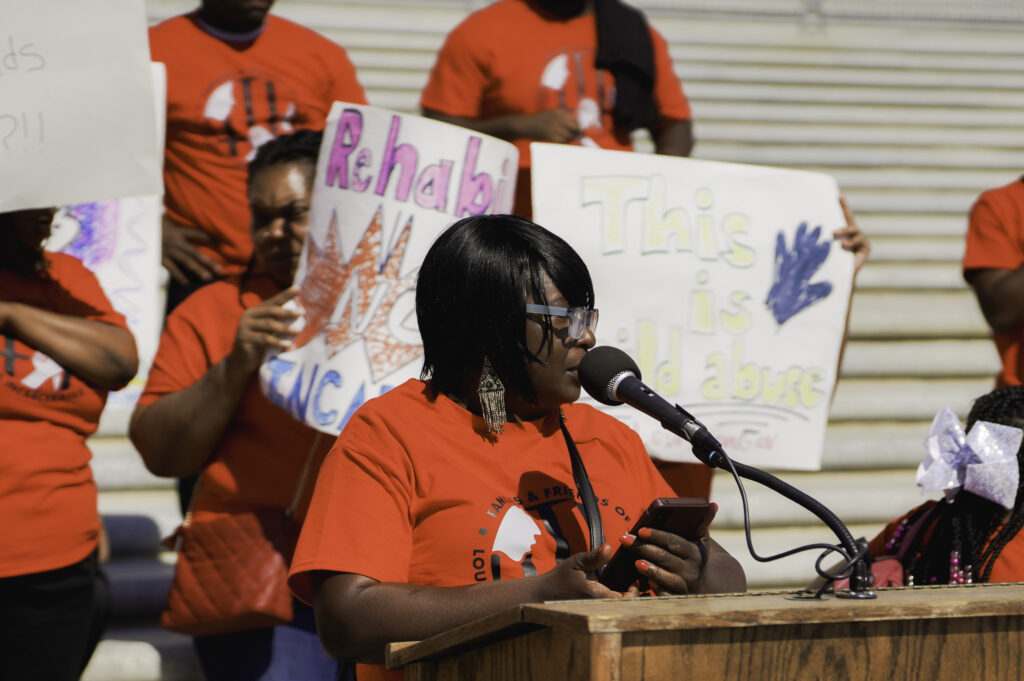
As our Governor, lawmakers, and the media continue to push harmful “tough on crime” proposals and rhetoric, advocates across the state are calling for a different path—one grounded in care, education, and community-based solutions. Among those leading the call is Satonia, a mother from Shreveport who shared her story.
Satonia’s journey began when her 17-year-old son, who has developmental challenges and learning difficulties, was sent into the adult prison system after his first run-in with the law. He didn’t fully understand why he was being incarcerated or what would happen to him—he believed he would soon be released. But instead, he found himself in a harsh adult facility, completely unprepared for what awaited him.
Inside prison, Satonia’s son witnessed and experienced trauma that continues to affect him today. Now in his early twenties, he still suffers from nightmares and has received no counseling, mental health care, or educational support, despite his learning challenges. He has not earned his GED. He remains, in many ways, frozen in the same developmental stage he was in when he entered the system.
Satonia has taken on the role of mentor, counselor, and caregiver for her son, but she worries about how she will support him in the days and years after he is released.
“What am I going to do with a child who has only been surrounded by a negative environment?” she asked. “He has so much trauma and needs so many resources and support.”
Her story is heartbreaking—and far too common in Louisiana, where youth are frequently funneled into adult facilities that offer no path to rehabilitation. Satonia made clear that the current system isn’t just failing young people—it’s harming entire families and communities.
“Sending children into the adult system only causes more harm… and makes us less safe,” she said.
In response to her son’s experience, Satonia began an organization called Something Safe To Do, which helps unhoused individuals access transitional housing and provides reentry and crime prevention services. Her work is rooted in a belief that safety comes from support, not incarceration.
She urges lawmakers and the public to recognize that children are fundamentally different from adults. Their brains are still developing, and their mistakes should be met with guidance—not punishment. Locking them up does nothing to address the root causes of their behavior, and it robs them of the opportunity to learn, grow, and heal. Instead, she is calling for a transformation of the state’s youth justice system into one that prioritizes education, mental health, and support services over incarceration.
“We all have a job and a part to play,” she said. “Because that’s what safety and crime prevention is truly about.”
Her words are a powerful reminder that real safety doesn’t come from punishment—it comes from care, community, and the courage to do what’s right for our youth.