As the 2026 Louisiana Legislative Session came to a close, Families and Friends of Louisiana’s Incarcerated Children (FFLIC) released the following statement warning that lawmakers advanced legislation that deepens the school-to-prison pipeline and expands reliance on incarceration over prevention and support:
Decades of research show that exclusionary discipline and justice system involvement harm youth and increase recidivism, while community-based supports and mental health care improve long-term outcomes.
“Our legislators sent a disheartening message to young people and families across Louisiana—that they are more interested in punishing them than supporting them,” said Jennifer Landry, a Chapter Lead with Families and Friends of Louisiana’s Incarcerated Children (FFLIC). “Instead of investing in mental health care, education, and violence prevention, lawmakers advanced policies that push more children into the legal system and keep them there longer.”
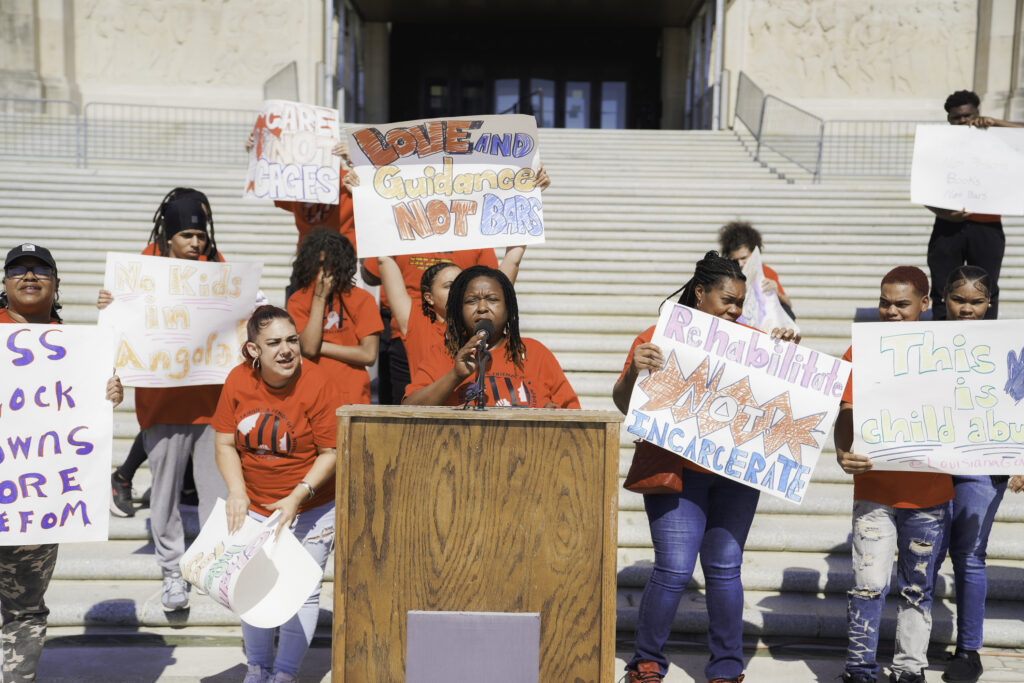
Throughout the session, youth leaders, families, and advocates traveled to the Capitol to oppose these measures and call for investments in education, mental health services, restorative practices, and community-based alternatives. Instead, policymakers advanced proposals—including efforts to expand secure-care beds in Vernon Parish—that increase punishment at every stage of the youth legal system and disproportionately harm Black youth, youth with disabilities, low-income families, and over-policed communities.
Louisiana should invest in prevention, healing, and community safety—not incarceration. Policymakers have yet to fulfill the promise of Act 1225 of 2003, which envisioned a coordinated, therapeutic system of care for youth and families.
Once again, the 2026 legislative session demonstrates a continued investment in systems that criminalize children and separate families rather than in prevention, healing, opportunity, and true community safety.
Policy Highlights (Selected Legislation)
The following bills illustrate the broader shift toward harsher, punishment-driven responses to youth behavior:
SB 201 would further restrict parole eligibility and resentencing opportunities for some individuals sentenced for offenses committed as children. This bill reduces opportunities for rehabilitation and second chances while ignoring decades of research showing that children are highly capable of growth and change.
HB 137 increases criminal penalties related to school threats and expands legal consequences for youth and their families, including detention, probation, and significant financial penalties. This bill risks increasing youth criminalization and funneling more young people into the legal system for behavior that may be connected to trauma, adolescent development, or unmet mental health needs, while relying primarily on punitive responses rather than prevention and support.
HB 140 is framed as procedural fixes to the youth justice system including the extension of time limits for court proceedings, but the real impact is more surveillance, longer involvement, and greater system reach over youth—especially those already in contact with the system.
HB 133 and HB 283 expand criminal penalties and exclusionary school discipline for incidents involving students and school staff, including mandatory detention, suspension, and expulsion tied to school-based behavior. Together, these bills continue the expansion of the school-to-prison pipeline by increasing reliance on punishment, court involvement, and removal from school, rather than prioritizing restorative practices, mental health support, and conflict intervention.
We also opposed budget proposals connected to HB 1 that would expand youth incarceration through the creation of additional secure-care beds in Vernon Parish.