When Antonio Travis first came to FFLIC, he wasn’t thinking about leadership. He was trying to survive. Growing up in New Orleans’ Seventh Ward, Antonio came of age in a system that was quick to punish and slow to understand. In school, he was frequently disciplined for “willful disobedience,” suspended and pushed out without anyone taking the time to ask what he was carrying—or why. Like many young people navigating trauma, instability, and the aftermath of Hurricane Katrina, he wasn’t given tools or support– only punishment.
At the time, Antonio didn’t have the language to describe what was happening. He just knew that the only attention he received came when something went wrong. As he later reflected, “the only time people gave me attention was when I got in trouble.” What he didn’t yet realize at that time was that his experience wasn’t personal failure—it was part of a larger system that mislabels unmet needs as misbehavior.
Finding FFLIC changed that.
Antonio came to the organization looking for somewhere he could speak and be heard. What he found was a space that helped him understand his story in a broader context. Through political education, organizing, and community building, he began connecting his experiences to patterns that extended far beyond his own life.
“I didn’t know how to articulate what I was going through,” he shared. “FFLIC gave me those tools—and I realized this was bigger than me.”
Alongside that awareness came skills he hadn’t been given in school: how to communicate, how to problem-solve, how to think critically about the world around him. Just as important, he began to see himself differently—not as a problem, but as someone with voice and potential.
Antonio began using that voice to speak publicly about his experiences in the charter school system, helping name policies that were pushing young people out instead of supporting them. Those opportunities expanded beyond New Orleans, placing him in spaces where his perspective mattered in ways it hadn’t before.
For Antonio, those moments weren’t just personal milestones. They reflected something larger about what becomes possible when young people are given the chance to be seen differently. “That was the same kid getting suspended,” he reflected. “Now I’m on TV talking about what’s really happening.”
Over time, his role in the work deepened. Leadership became less about being heard and more about creating space for others. He began intentionally bringing peers into the organization, making sure they knew there was a place where they could grow, be supported, and be taken seriously.
“One of my biggest accomplishments is being able to tell people from my community—there’s a space for you here.”
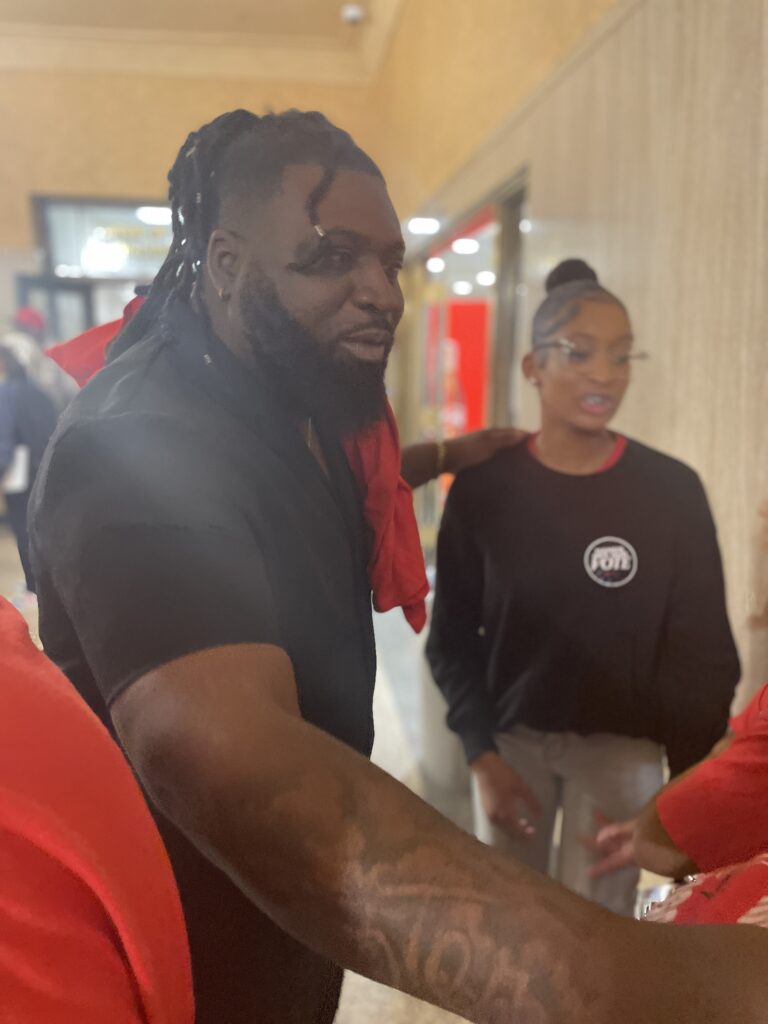
Today, more than a decade later, Antonio stands in that same organization as FFLIC’s Leadership Development Manager—a full-circle moment that reflects both his journey and the organization’s long-term commitment to young people. In his current role, he leads the development of youth leaders across the state, guiding them through political education, organizing, and leadership-building. He is now overseeing FFLIC’s second cohort of youth leaders, while members of the first cohort step into mentorship roles. It’s a cycle that reflects what sustained investment in young people can look like over time.
“Young people have power. They always have,” he says. “My job is to help them see it—and build it.”
Antonio’s leadership is grounded in authenticity, accountability, and a commitment to care—meeting young people where they are and ensuring they have what they need to grow.
At the center of that work is a clear vision: a Louisiana where young people are supported instead of incarcerated, where investment in communities replaces reliance on systems that punish rather than heal.
“We’re organizing so young people can be at the forefront,” he explains. “Not just talked about—but making decisions.”
As FFLIC marks 25 years, Antonio’s story reflects what it means to invest in young people—not just in moments, but across time. From a young person searching for a place to be heard to a leader building pathways for others, his journey holds both the weight of what could have been and the possibility of what comes next.
“I’ve dedicated my life to this work,” he says. “I just want to make sure the next young person has everything they need.”
And through that commitment, the legacy continues.